Contact Us
STATEN ISLAND FIBERAMA
Choosing the right Sliding Glass Doors manufacturer affects more than a room’s appearance. It influences daylight, ventilation, energy use, security, and daily comfort. In a well-designed home, the door should glide quietly, close evenly, and frame the view without distracting hardware. A poorly selected system may show its weaknesses through rattling panels, water leaks, or difficult operation.
Industry expert Joe Altieri, a veteran fenestration consultant, states, “A sliding door must perform as beautifully as it looks.” This principle guides our review of China’s leading manufacturers and suppliers. We examine product quality, frame materials, glass options, thermal performance, customization, certifications, and after-sales service. These details matter when buyers compare aluminum, uPVC, and thermally broken systems.
China’s market includes large factories and specialized workshops. Their capabilities can differ greatly. Some suppliers offer automated production and strict inspection records. Others depend heavily on manual assembly. That difference may not appear in a catalog photo.
This guide highlights manufacturers with practical strengths and identifiable product advantages. It also considers export experience, packaging methods, lead times, and communication reliability. Still, no supplier is perfect. A lower price may hide limited testing or weaker support. Even attractive designs deserve careful questions.
Look closely. Ask for evidence. Compare real performance, not only polished brochures.
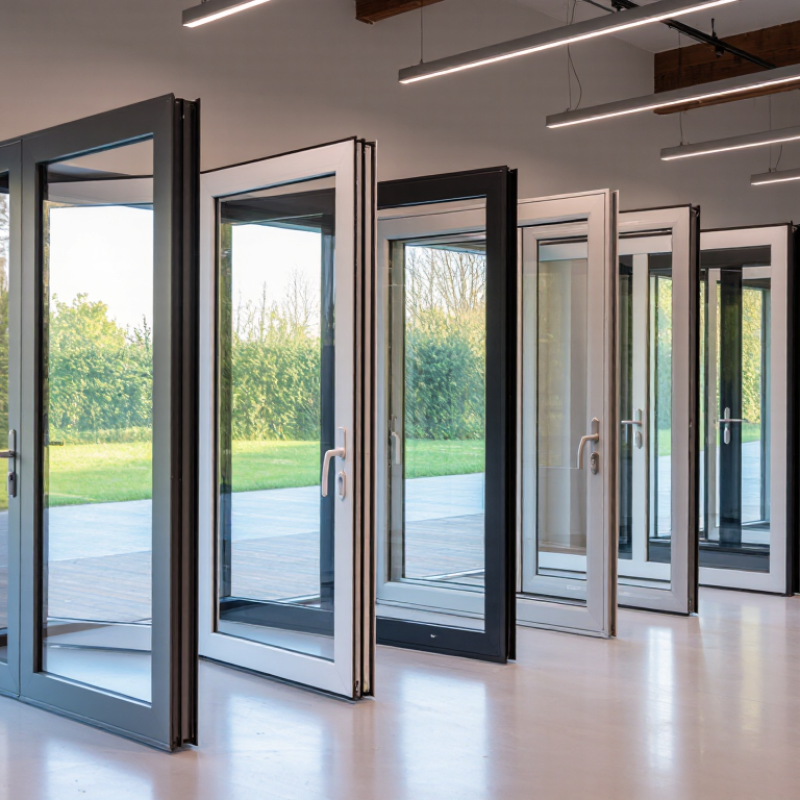
Chinese manufacturers produce several sliding glass door types for homes, offices, hotels, and retail spaces. Standard framed doors commonly use tempered glass, aluminum profiles, and adjustable rollers. They suit balconies and patios because they provide ventilation without occupying swing space.
Lift-and-slide doors use reinforced rollers and a handle-operated lifting mechanism. The panel rises slightly before moving, reducing friction on wide openings. These doors often combine double glazing, low-emissivity coatings, and thermal-break frames. They perform well in colder regions, but the final result depends on accurate installation and drainage design.
Frameless sliding doors create a cleaner visual effect for interiors, bathrooms, and enclosed balconies. Pocket doors disappear into wall cavities, saving valuable floor space. Folding-sliding systems can open wider, although their hardware requires careful alignment. Some suppliers also make laminated glass doors for improved impact resistance and noise control. Check glass thickness, corner joints, roller capacity, seals, and surface finish before ordering. Small details matter. Site measurements should include wall tolerance, floor level, and wind exposure. A beautiful door can still leak if the threshold is poorly installed. No single design fits every project. Supplier drawings, sample testing, and clear hardware specifications make comparisons more reliable.

Sliding glass doors made in China are commonly produced in two-, three-, and four-panel configurations. Two-panel systems are widely used for balconies and residential entrances, while three- and four-panel systems are suitable for wider openings and multi-track installations. The figures show representative panel counts rather than market-share data.
When comparing China’s sliding glass door manufacturers and suppliers, technical data matters more than polished catalogs. The U.S. Department of Energy reports that windows can cause 25–30% of residential heating and cooling energy use. Therefore, buyers should compare U-factor, solar heat gain coefficient, visible transmittance, and air leakage. Lower U-factor usually improves insulation. However, excessive solar control may reduce useful daylight.
Check whether suppliers provide NFRC-style performance data, not only glass descriptions. NFRC testing evaluates U-factor, SHGC, visible transmittance, and condensation resistance. Frame design also matters. Thermally broken aluminum, insulated spacers, and multi-point seals can reduce cold-edge condensation. Small details matter. A beautiful door can still perform poorly.
Ask for test evidence under recognized standards, including ASTM E283 for air leakage, ASTM E330 for structural performance, and ASTM E547 for water penetration. The AAMA/WDMA/CSA 101/I.S.2/A440 standard also helps classify overall fenestration performance. IEA data shows buildings remain responsible for about 30% of global final energy consumption, making efficiency a practical purchasing issue. Still, test results may not represent real installation. In project reviews, drainage paths and uneven thresholds often create problems. Suppliers should provide installation drawings, tolerances, hardware cycle data, and warranty terms. This is where comparisons become less perfect, but more honest.
China’s leading sliding glass door manufacturers are serving a fast-changing construction market. China’s National Bureau of Statistics reported a 66.16% urbanization rate in 2023. This supports continued demand for space-saving doors in apartments, hotels, offices, and retail projects.
Manufacturing quality begins with measurable details. Experienced Chinese suppliers commonly offer thermally broken aluminum frames, Low-E insulating glass, stainless-steel rollers, and adjustable hardware. A 2024 report from the International Energy Agency states that buildings consume about 30% of global energy. Therefore, frame insulation and glass performance deserve more attention than surface appearance. Reliable factories should provide air, water, wind-load, and operating-cycle test records. They should also explain glass thickness, spacer type, drainage design, and hardware load limits.
Factory visits reveal practical differences. Some production lines use automated cutting and digital inspection. Others still depend heavily on manual assembly. That difference can affect corner alignment and sliding resistance. It is easy to overlook. Buyers should review sample doors under repeated opening, not only polished showroom samples. Documentation such as ISO 9001 procedures, batch traceability, and export inspection records adds confidence. However, certificates do not replace physical testing. A supplier may present excellent drawings yet miss small installation tolerances. This remains a common weakness. Clear drawings, controlled packaging, and responsive technical support often matter as much as the door itself.
Choosing a Chinese sliding glass door supplier requires more than comparing catalog prices. Start by checking factory experience, production records, and product specifications. Ask how they control glass thickness, frame alignment, roller durability, and sealing performance. A reliable factory should provide clear drawings, material certificates, inspection procedures, and realistic lead times.
Visit the facility when possible. Observe cutting areas, assembly lines, storage conditions, and final inspection stations. Clean workspaces do not guarantee quality, but poor organization often reveals hidden risks. Request a sample door and test its movement, locking force, drainage, and noise level. One sample is not enough. Production consistency matters more. Verify whether key processes are performed in-house or outsourced. This detail is easy to miss, and it can affect both quality and delivery.
Tips: Ask for a small trial order before signing a large contract. Use written acceptance standards with measurable tolerances. Confirm packaging with corner protection, foam layers, and moisture-resistant materials. Check how the supplier handles defects, replacement parts, and delayed shipments. Factory audits and third-party inspections add useful evidence, but they are not perfect. I have learned that attractive samples can hide weak batch control. Keep communication documented, especially for glass dimensions and hardware finishes. A capable supplier welcomes precise questions. A careless one often answers too quickly.
| Evaluation Dimension | Practical Benchmark or Requirement | Documents or Evidence to Request | Recommended Verification Method | Suggested Weight |
|---|---|---|---|---|
| Product Scope | Capability to supply interior, exterior, thermal-break, lift-and-slide, or multi-panel sliding glass door systems according to the project specification. | Product catalog, technical drawings, section profiles, available panel dimensions, and configuration list. | Compare the supplier’s standard range with the required opening sizes, glass types, hardware, finishes, and installation conditions. | 10% |
| Glass Compliance | Use safety glazing appropriate to the application. Common reference standards include tempered glass requirements under EN 12150, laminated glass under EN 14449, or equivalent destination-market standards. | Glass declarations, test reports, heat-soak or fragmentation records where applicable, and glass thickness specifications. | Check the report scope, glass composition, thickness, test date, laboratory details, and whether the report matches the supplied configuration. | 12% |
| Insulating Glass Capability | For double-glazed units, the supplier should control spacer installation, sealing, gas filling where specified, and edge-seal quality. EN 1279 is a recognized reference for insulating glass units. | Insulating-glass test reports, production process records, spacer specifications, sealant technical data, and gas-filling records if applicable. | Confirm that the tested unit construction is identical to the quoted unit, including glass thickness, spacer, coating, sealant, and gas type. | 8% |
| Frame and Profile Quality | Profiles should have consistent wall thickness, accurate dimensions, stable surface treatment, suitable drainage design, and sufficient structural capacity for the specified glass load. | Profile drawings, alloy or material specifications, wall-thickness data, coating specifications, and structural calculations where required. | Measure random profile samples and compare them with approved drawings; inspect corners, drainage paths, gaskets, and surface finish. | 10% |
| Hardware and Load Capacity | Rollers, locks, handles, anti-lift devices, and tracks should be selected according to panel weight, operating frequency, corrosion exposure, and security requirements. | Hardware specifications, maximum panel-weight rating, cycle-test data, spare-parts list, and maintenance instructions. | Verify the actual panel weight against the hardware rating and operate a fully assembled sample repeatedly under normal conditions. | 10% |
| Air, Water, and Wind Performance | Exterior systems should be tested for air permeability, watertightness, wind resistance, and operational performance under the requirements of the destination market. | Complete performance test reports, tested dimensions, installation method, pressure levels, pass/fail results, and applicable standard. | Check whether the report covers the same system, size, number of panels, glass specification, and drainage arrangement as the proposed product. | 12% |
| Thermal and Acoustic Performance | Performance depends on frame design, glass composition, spacer, seals, panel size, and installation. U-value and sound-reduction claims must be tied to a specific tested or calculated configuration. | Thermal calculations or test reports, solar-control glass data, acoustic reports, and the complete unit build-up. | Confirm calculation boundaries and compare the declared values with local building-code or project requirements. | 8% |
| Factory Production Controls | A capable factory should control incoming materials, cutting, machining, assembly, glazing, sealing, inspection, labeling, and final packing through documented procedures. | Quality manual, inspection plan, process-control records, calibration certificates, nonconformity records, and production photographs or audit access. | Conduct a remote or on-site audit and trace a sample order from raw material receipt to shipment. | 10% |
| Quality Management System | An ISO 9001-certified quality management system can indicate documented processes, but certification alone does not prove product performance or manufacturing capacity. | Valid certificate, certification scope, issuing body, audit status, and corrective-action procedure. | Verify certificate validity and scope independently, then assess actual process records and product inspection results. | 6% |
| Customization and Engineering Support | The supplier should be able to prepare shop drawings, resolve interface details, adapt profiles or hardware, and provide installation guidance without compromising tested performance. | Sample shop drawings, engineering change procedure, installation manuals, calculation examples, and project approval workflow. | Issue a controlled technical brief and assess the accuracy, speed, and completeness of the supplier’s response. | 6% |
| Packaging and Export Logistics | Packaging should protect glass, finished profiles, hardware, and assembled frames from impact, moisture, abrasion, and deformation during inland and sea transport. | Packing specification, loading plan, container photos, moisture-protection method, shipping marks, and damage-claim procedure. | Inspect a packed sample or previous shipment and confirm that packaging matches the agreed transport route and handling conditions. | 4% |
| After-Sales Service and Spares | The supplier should provide installation support, replacement seals and rollers, warranty terms, response times, and a documented process for handling defects. | Warranty document, spare-parts catalog, service-level commitments, troubleshooting guide, and claims records with personal data removed. | Evaluate response time using technical questions and verify whether critical spare parts remain available for the expected service period. | 4% |
| Total Evaluation Weight | Use a weighted score from 1 to 5 for each dimension: 1 = insufficient evidence, 3 = acceptable, 5 = strong and independently verified capability. | Prioritize independently verifiable documents and configuration-specific testing over general marketing statements. | Recommended minimum: technical document review, sample inspection, factory audit, and pre-shipment inspection. | 100% |
When ordering sliding glass doors from China, begin with a precise product brief. Include opening size, frame material, glass thickness, finish, hardware, and installation location. Share drawings, photos, and acceptable tolerances. Small details matter.
Request a written quotation with unit pricing, tooling charges, minimum order quantity, lead time, and payment terms. Confirm whether prices include packaging, inspection, and inland transport. A sample should match the final production structure, not merely its appearance. Check glass markings, edge finishing, roller movement, lock alignment, drainage holes, and surface consistency. Independent inspection can verify dimensions, glass type, quantity, and visible defects before shipment. Factory testing records are useful, but they should not replace physical checks. I have seen attractive samples hide weak rollers and uneven seals. That mistake becomes expensive.
Packaging deserves equal attention. Each panel needs separation, corner protection, moisture resistance, and a strong crate. Ask for loading photos and a packing list before dispatch. Confirm the shipping method, port, insurance responsibility, and delivery terms in writing. Measure the crate dimensions carefully because oversized cargo can change freight costs. Keep spare hardware and installation instructions in a labeled carton. Sea transport is economical, but schedules can shift. Build a buffer into your project plan. A perfect checklist does not exist. Recheck everything.
© 2025 Fiberama All Rights Reserved.