What Is a Folding Door and How Does It Work?
A Folding Door can change how a room feels, works, and connects with the outdoors. Unlike a conventional hinged door, it uses several hinged panels that slide along a track and fold into a compact stack. When opened, the panels may create a wide, mostly unobstructed passage. When closed, they form a practical barrier against weather, noise, and unwanted drafts.
Ebrahim Nana, founder of NanaWall and a recognized figure in large-opening door design, describes the basic idea this way: “A door should open the room, not close it off.” That principle explains why homeowners, architects, and hospitality designers continue to choose Folding Door systems. Still, openness is not automatic. Track alignment, panel weight, frame strength, drainage, glazing, and installation quality all affect daily performance.
A well-designed system should move smoothly, without forcing or sudden resistance. Small details matter. A blocked bottom track can quickly become a frustrating obstacle. Poor sealing may also reduce comfort during heavy rain or strong wind. These limitations deserve attention, even when the finished installation looks elegant.
This guide explores what a Folding Door is, how its panels move, and which components make that movement possible. It also considers interior and exterior applications, maintenance needs, energy performance, and common installation mistakes. The goal is not to present folding doors as perfect solutions. Instead, it offers a practical explanation for choosing, using, and evaluating them with realistic expectations.
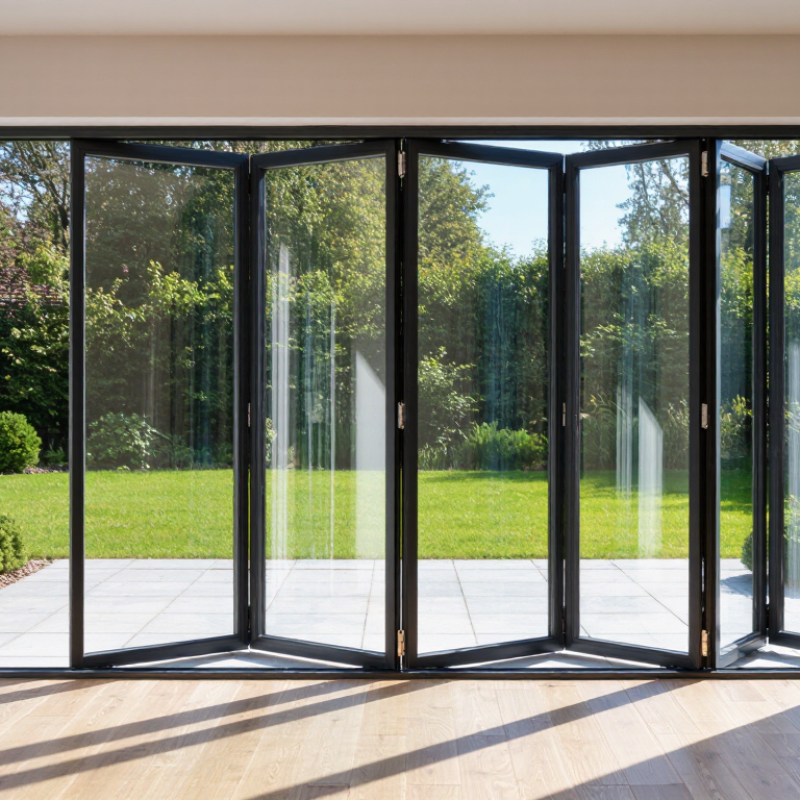
Folding Door Definition: 2–8 Panels Connected by Hinges
What Is a Folding Door and How Does It Work?
A folding door is a movable wall made from two to eight panels connected by hinges. Each panel usually has a glass, timber, or composite surface inside a strong frame. When the door opens, the panels fold together instead of swinging across the room. This design needs less clearance than a traditional hinged door. It can also create a wide opening between indoor and outdoor areas.
Most folding doors run on a top track, bottom track, or both. Rollers guide the panels along the opening, while hinges control their movement. Some systems use a lead panel that moves first and pulls the remaining panels into a stack. The folded panels may collect at one side or split toward both ends. Accurate measurements matter. A few millimeters of error can affect alignment, sealing, and smooth operation.
In practical installations, the floor must remain level and free from debris. Hinges need regular inspection because loose fasteners can make the panels sag. Weather seals help reduce drafts, but they are not perfect. Heavy glass panels also require careful handling and suitable structural support. I once assumed more panels always meant a wider, better opening. That is not necessarily true. More hinges can add flexibility, yet they may also increase adjustment points and maintenance needs. The best configuration depends on the opening size, panel weight, traffic, and available stacking space.
Key Components: Tracks, Rollers, Pivots, Guides, and Locking Hardware
A folding door is a linked panel system that opens by sliding and pivoting. Its performance depends less on panel size than on the hardware carrying each movement. The top track supports the running load. Rollers travel inside it, reducing friction and keeping panels aligned. Bottom guides limit sideways movement, while pivots control how the first and last panels turn. Locking hardware then secures the closed stack and helps maintain compression around the seals.
Track stiffness matters. A slightly deflected track can create uneven gaps, noisy rollers, and difficult operation. Rollers should match the panel weight, not merely the door’s appearance. Pivots need accurate fixing because small errors multiply across several panels. Guides should resist sway without trapping dirt. This detail is often underestimated. A practical inspection should check smooth travel, fastener tightness, drainage, seal contact, and lock engagement.
The U.S. Department of Energy reports that windows can account for 25–30% of residential heating and cooling energy use. Large glazed folding doors deserve similar attention to air leakage and solar gain, although their results vary by orientation and installation. Industry testing under recognized fenestration standards evaluates air, water, and structural performance, but laboratory results cannot correct poor site alignment. In my view, installers should leave adjustment access; sealed hardware is harder to service later. It is an imperfect detail, yet a useful one.
How It Works: Panel Loads Transfer Through Hinges and Rollers
A folding door uses connected panels that open like an accordion. Its movement depends on two load paths: hinges between panels and rollers beneath the panels. The hinges keep each panel aligned, while rollers carry much of the vertical weight along the track. The hinges pivot. That distinction matters.
During operation, panel weight transfers through hinge knuckles, fasteners, roller carriers, and the floor track. A taller glass panel creates greater leverage against the hinge screws. Misaligned rollers can increase friction, forcing users to pull harder. That extra force may distort the frame or loosen hardware over time. Field inspections often reveal a simple problem: the track is clean, but the rollers are incorrectly adjusted.
Structural performance also depends on installation, not hardware alone. ASTM E330/E330M evaluates doors under uniform static air pressure, helping assess frame and panel resistance. However, laboratory pressure does not reproduce every building movement or wind condition. The American Society of Civil Engineers’ ASCE 7 standard requires site-specific wind-load calculations, especially for exposed openings. Engineers should compare those loads with the door system’s tested capacity.
Energy performance deserves attention too. The U.S. Department of Energy reports that windows account for roughly 25–30% of residential heating and cooling energy use. Large glazed folding doors behave similarly, particularly when seals compress unevenly. A narrow daylight gap can become a noticeable draft. I would not treat smooth operation as proof of correct loading. It is only one clue.
