China Top Double End Bolt Manufacturer for Global Buyers?

Global buyers need more than a low quotation when sourcing a Double End Bolt from China. They need stable dimensions, verified steel, predictable delivery, and clear technical communication. World Steel Association’s World Steel in Figures 2024 reports that China produced about 1.019 billion tonnes of crude steel in 2023. This scale supports a deep industrial supply chain. It does not automatically prove every manufacturer is reliable.

A capable China Top Double End Bolt Manufacturer should connect production data with practical inspection. Buyers should review material certificates, thread gauges, hardness results, tensile testing, and coating records. ISO 898-1 provides widely recognized mechanical property requirements for carbon steel and alloy steel fasteners. For stainless products, ISO 3506 offers another important reference. These standards create a useful starting point, but application requirements still matter. A bolt used in a steel structure is not identical to one installed in machinery or chemical equipment.

International Trade Centre Trade Map can help buyers examine fastener trade patterns and supplier markets. However, trade statistics rarely reveal factory discipline, packaging quality, or corrective-action speed. That gap matters. A supplier may present attractive samples, yet production consistency can weaken under pressure. Experienced buyers therefore compare inspection reports, batch traceability, thread fit, and real shipment photographs. They also confirm tolerance, grade, surface treatment, and customized length before ordering.

This guide examines how global buyers can evaluate a Chinese manufacturer with greater confidence. It considers engineering capability, quality controls, export experience, and communication. The process is not perfect. Claims require verification. Good sourcing begins with evidence, not promises.

China Top Double End Bolt Manufacturer for Global Buyers?

What Is a Double End Bolt and Where Is It Used?

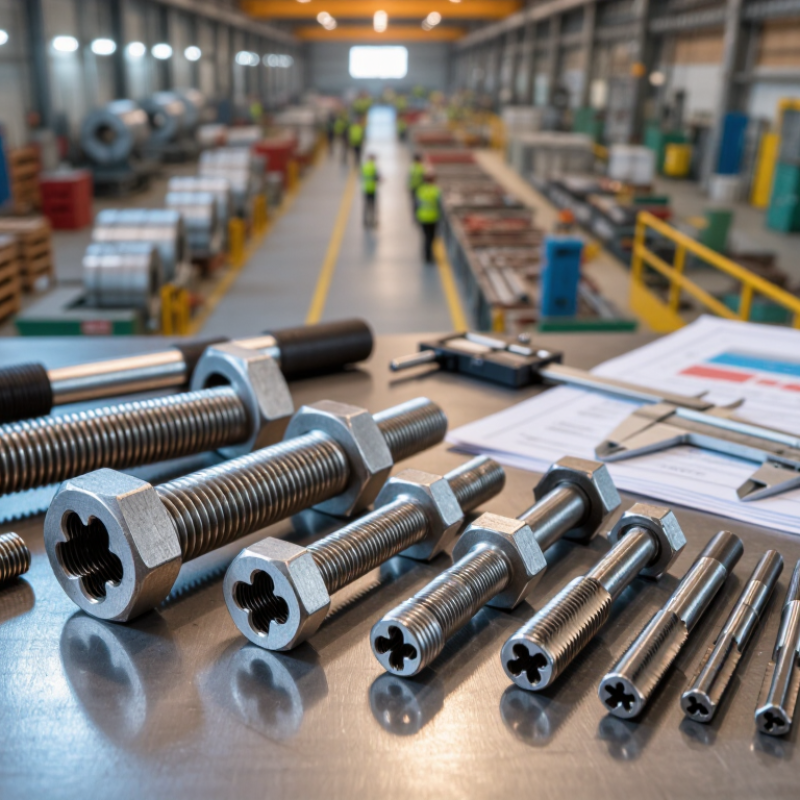
A double end bolt, often called a double-ended stud, has threads on both ends. Its center section may remain smooth for clearance and alignment. One end enters a tapped hole, while the other accepts a nut and washer. This design joins two components without turning the entire fastener during assembly.

These fasteners appear in pipe flanges, engine covers, pumps, gearboxes, and structural equipment. They are useful where repeated removal could damage a threaded housing. For example, a stud fixed in a steel flange helps guide a heavy cover into position. Material, thread size, length, and surface treatment must match the working environment. Heat, vibration, moisture, and installation torque all matter.

Tips: Check thread standards before ordering. Measure the exposed thread length, not only the total length. Request material certificates and dimensional inspection records for critical applications. A trial assembly can reveal poor fit early. I would not rely on appearance alone; even a polished surface can hide incorrect hardness or thread accuracy. The term “double end bolt” is also used differently by some suppliers, so drawings should confirm every dimension. Small misunderstandings here can delay an entire production line.

Key Factors for Evaluating Chinese Double End Bolt Manufacturers

China Top Double End Bolt Manufacturer for Global Buyers?

Evaluating a Chinese double end bolt manufacturer requires more than comparing prices. Grand View Research estimates the global fasteners market will continue growing through 2030, increasing pressure on suppliers and quality systems. Ask for material certificates, heat-treatment records, and lot-level traceability. A reliable factory should identify steel grade, tensile strength, thread tolerance, and coating thickness clearly.

ISO 898-1 provides mechanical requirements for carbon and alloy steel fasteners. Check whether the manufacturer tests against the correct property class. Request independent reports for tensile, hardness, thread gauge, and salt-spray performance. Inspect production details, including cold heading, CNC threading, chamfering, and final sorting. Sample bolts should match the drawing, not merely look polished.

Production capacity also needs proof. Review monthly output, inspection staffing, equipment maintenance, and packaging controls. The United Nations Comtrade database shows China remains a major global exporter of iron and steel fasteners, but export volume alone cannot prove consistency.

A low quote can still be wrong. I would audit the factory before approving a large order, especially when dimensions are customized. Some suppliers present excellent certificates yet lack stable batch control. That gap is easy to miss. Require corrective-action records, clear lead-time commitments, and secure packaging that prevents thread damage during ocean transport.

How China’s Leading Manufacturers Control Bolt Quality

China Top Double End Bolt Manufacturer for Global Buyers?

Quality control starts with the steel, not the final inspection table. The World Steel Association’s World Steel in Figures 2024 reports that China produced 1,019.1 million tonnes of crude steel in 2023. This scale supports stable sourcing, but volume alone proves little. Reliable manufacturers verify heat numbers, chemical composition, and mill certificates before production begins.

During manufacturing, controlled cold forming or machining protects thread accuracy and grain flow. Technicians check pitch diameter with calibrated gauges. They also test hardness, tensile strength, and proof load against ISO 898-1 requirements. Lot numbers should follow each bolt from raw material storage to packing. The ISO Survey 2023 recorded 1,265,216 ISO 9001 certificates worldwide. However, certification measures a management system, not every finished bolt. That distinction matters.

I have seen clean samples fail when production batches changed. A certificate cannot replace independent testing. Good factories retain samples, inspect coating thickness, and investigate abnormal results instead of hiding them. Not perfect. Human error remains possible. Buyers should request inspection records, test methods, and traceability photographs before shipment. Clear drawings also prevent costly assumptions about shank length, thread engagement, and surface treatment. For critical assemblies, third-party sampling adds useful resistance to optimistic factory reports. That extra step may feel slow, but it protects field performance.

Ordering and Customizing Double End Bolts for Global Projects

Ordering and Customizing Double End Bolts for Global Projects

Global projects need more than a standard double end bolt. They need predictable fit, traceable production, and clear communication. A China-based manufacturer should review the drawing before quoting. Thread diameter, pitch, overall length, stud length, and unthreaded sections must be confirmed. Small errors can delay an entire installation.

Buyers should specify the required thread standard, such as metric or unified threads. Material selection may include carbon steel, alloy steel, or stainless steel. Strength grades, heat treatment, surface coating, and corrosion exposure also affect performance. For outdoor structures, coating thickness deserves careful attention. It is easy to overlook.

Customization works best with approved drawings and physical samples. The supplier can verify thread gauges, dimensions, hardness, and visual quality during production. Independent inspection may add confidence for critical orders. Batch numbers and inspection records support traceability. Packaging should separate threaded ends and protect them from impact, moisture, and mixed sizes.

A dependable quotation should show tooling costs, minimum order quantities, lead time, and delivery terms. Samples can reveal practical issues that drawings miss. We have seen thread lengths adjusted after assembly trials. That experience matters. Yet no supplier is perfect, and assumptions still cause problems. Buyers should confirm every revision in writing before mass production. Clear questions often prevent expensive rework.

Export, Certification, and After-Sales Support for International Buyers

International buyers need more than a low quotation when sourcing double end bolts from China. A dependable manufacturer should provide dimensional inspection records, heat numbers, and material certificates for every production batch. ISO Survey 2022 reported more than 1.2 million ISO 9001 certificates worldwide, showing how common quality systems have become. Certification alone, however, does not prove consistent bolt performance.

Export control begins with clear product identification. Buyers should confirm thread standards, steel grade, coating thickness, tensile strength, and packaging details before production. Testing should reference suitable standards, such as ISO 898-1 or ASTM requirements, depending on the project. An EN 10204 3.1 inspection certificate can connect the finished bolts with their original steel batch. Customs invoices should also match the actual quantity, weight, and product description. Small errors can delay a container.

Tips: Request a pre-shipment sample, signed inspection checklist, and photos of carton labels. Confirm whether certificates cover the exact batch. Ask about replacement procedures, response times, and spare inventory before placing a large order. The World Bank’s 2023 Logistics Performance Index highlights customs and shipment visibility as key trade factors. Reliable suppliers should therefore share loading photos, tracking updates, and clear export documents. After-sales support remains imperfect in real projects. A thread may be damaged during inland transport. A careful supplier will investigate evidence, not simply blame installation. Regular reviews can expose weak packaging, slow replies, or repeated dimensional variation.

China Top Double End Bolt Manufacturer for Global Buyers? – Export, Certification, and After-Sales Support for International Buyers
Evaluation Dimension Relevant Data or Standard What International Buyers Should Verify Recommended Documentation or Evidence
Product Definition Double-end bolts, commonly called double-ended studs, have external threads on both ends and an unthreaded or partially threaded center section. Confirm the screwed-end length, nut-end length, overall length, thread pitch, thread class, and center-body diameter on the approved drawing. Technical drawing, dimensional specification, and signed order confirmation.
Common Dimensional Standards DIN 938 is commonly used for studs with a short screwed end; DIN 939 is commonly used for studs with a longer screwed end. Ensure the selected standard matches the equipment design and that metric dimensions are not mixed with inch dimensions. Applicable standard designation, revision date, and customer-approved product drawing.
Mechanical Property Classes ISO 898-1 defines mechanical and physical properties for carbon-steel and alloy-steel bolts, screws, and studs. Common property classes include 8.8, 10.9, and 12.9. Check tensile strength, yield or proof strength, hardness, and the required property class for the application. Mill test certificate, mechanical test report, and batch traceability record.
High-Temperature or Pressure Applications ASTM A193 covers alloy-steel and stainless-steel bolting for high-temperature or high-pressure service. Grade B7 is a widely specified alloy-steel grade under this standard. Confirm the required material grade, heat-treatment condition, temperature range, and compatibility with the mating components. Material certificate, heat-treatment record, chemical analysis, and mechanical test results.
Material Traceability Traceability normally links each production batch to a heat number, raw-material certificate, production record, and final inspection report. Verify that the marking and documentation identify the same batch shipped in the container or package. Heat-number records, batch labels, inspection reports, and packing-list references.
Thread Accuracy Metric external threads are commonly specified with ISO metric thread profiles, while inch threads may use Unified National Coarse or Unified National Fine profiles. Confirm nominal diameter, pitch or threads per inch, tolerance class, thread direction, and effective thread length. Thread plug and ring gauge records, dimensional inspection report, and sample approval.
Coating and Corrosion Protection ISO 4042 addresses electroplated coatings for fasteners, while ISO 10683 addresses non-electrolytically applied zinc-flake coatings. Specify coating type, coating thickness, corrosion requirement, hydrogen-embrittlement controls, and torque-tension requirements where applicable. Coating certificate, thickness report, salt-spray test report when contractually required, and process-control record.
Quality Management ISO 9001 is an internationally recognized quality-management-system standard. Certification applies to the documented management system and stated scope. Check the certificate validity, certification scope, issuing certification body, and whether the manufacturing site is covered. Current ISO 9001 certificate and certification-body verification record.
Inspection and Acceptance ISO 3269 provides general requirements for acceptance inspection of fasteners unless a purchase contract specifies different requirements. Define sampling level, critical dimensions, visual requirements, mechanical tests, nonconformance handling, and inspection responsibility before production. Inspection and test plan, first-article report, final inspection report, and agreed acceptance criteria.
Export Classification Iron or steel threaded bolts and similar fasteners are generally classified under HS heading 7318.15, subject to the exact product description and customs rules. Confirm the tariff subheading with the customs broker in the destination country because national tariff extensions may differ. Commercial invoice, product description, HS code confirmation, and customs declaration data.
Export Documentation Typical international shipments use a commercial invoice, packing list, transport document, and, where applicable, a certificate of origin. Make sure quantities, net and gross weights, package marks, part numbers, Incoterms® rule, and consignee information are consistent across documents. Commercial invoice, packing list, bill of lading or air waybill, certificate of origin, and insurance document when required.
Packaging for Overseas Transport Fasteners are commonly packed in sealed inner bags or cartons, placed in export-suitable cartons, and secured on pallets or in crates where needed. Specify corrosion-inhibiting packaging, moisture protection, package weight limits, carton markings, pallet requirements, and container loading instructions. Approved packaging specification, packing photographs, package-weight record, and loading checklist.
Pre-Shipment Inspection Inspection may include quantity verification, visual examination, dimensions, thread gauging, hardness, tensile testing, coating checks, and document review. Agree whether inspection is performed by the manufacturer, an independent inspection agency, or the buyer’s representative. Pre-shipment inspection report, test certificates, photographs, and nonconformance closure record.
Delivery Planning Actual production and transport time depends on size, material, coating, quantity, tooling, inspection requirements, port schedules, and destination country. Request a written production schedule with drawing approval, raw-material arrival, machining, heat treatment, coating, inspection, packing, and dispatch milestones. Manufacturing schedule, order milestone report, booking confirmation, and shipping advice.
After-Sales Support Professional support normally covers technical clarification, replacement of verified nonconforming goods, corrective-action analysis, and document reissue. Define response time, claim-submission period, evidence requirements, replacement or credit procedure, freight responsibility, and warranty exclusions. Written warranty terms, claims procedure, corrective-action report, and approved replacement policy.
Supplier Selection Indicator A reliable manufacturer should be able to provide consistent specifications, traceable batches, controlled inspection records, export documentation, and clear contractual responsibilities. Evaluate technical capability, quality-system evidence, sample consistency, communication speed, delivery performance, and transparency of nonconformance handling. Supplier questionnaire, sample inspection, audit report, reference project evidence without confidential customer information, and signed quality agreement.
Standards and customs classifications should be confirmed against the latest applicable edition, purchase specification, and destination-country regulations before placing an international order.
Contact us

Let's Get Started!

Competitive Pricing and Exceptional Service!