Contact Us
STATEN ISLAND FIBERAMA
Choosing the best Wall-Mounted Display Racks in 2026 starts with the job they must do. A rack should suit the merchandise, wall construction, available space, and expected customer reach. It should also support its stated load without wobbling or blocking nearby products. Small details matter.
Retail data helps explain why display choices deserve attention, but it cannot name a winning rack. The U.S. Census Bureau reported that 2024 U.S. e-commerce sales reached $1.1926 trillion, up 8.1% from 2023, and represented 16.1% of total retail sales. The National Retail Federation’s 2025 forecast projected U.S. retail sales of $5.42 trillion to $5.48 trillion. These figures describe the wider retail environment, not demand for any specific fixture. A useful rack still depends on the store’s products and layout.
This guide compares rack types by material, adjustability, capacity, installation needs, and visual impact. A slim metal rail may keep packaged goods easy to scan, while deeper shelves can hold bulkier items. Yet a tidy display can still be wrong for the wall behind it. Check the manufacturer’s load guidance and confirm that the mounting method suits the wall surface. There is no universal best. The right choice is the one that keeps products visible, accessible, and securely supported in your actual space. Industry statistics offer context; careful measurement and product documentation should guide the final decision.
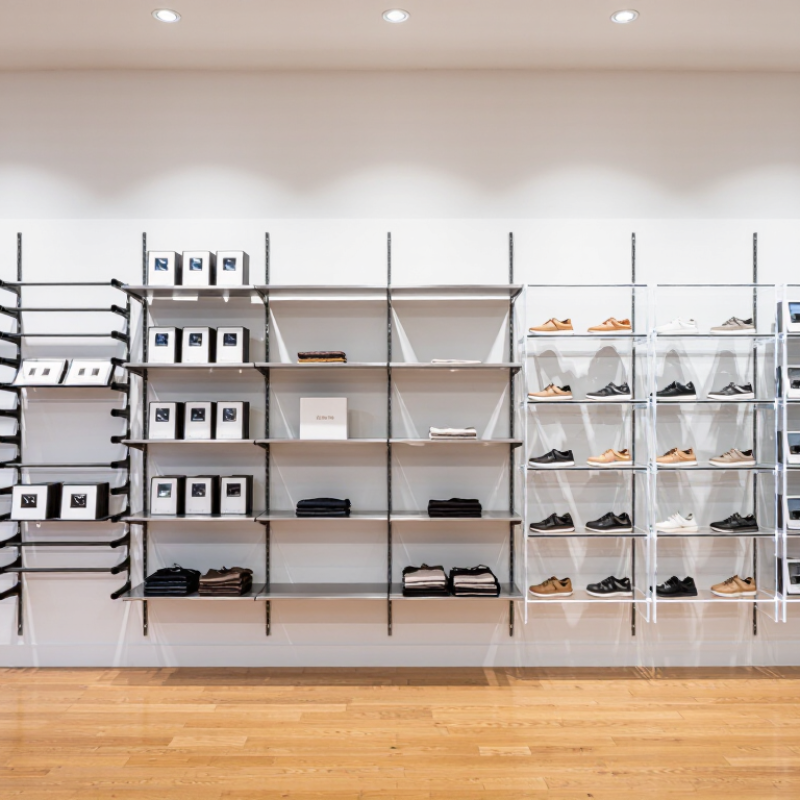
Wall-mounted display racks are fixed storage and merchandising systems that hold products on vertical surfaces. Common designs use shelves, hooks, rails, or slotted panels. Brackets transfer the load through fasteners into wall studs, masonry, or other suitable backing. The rack’s appearance is only part of the system. Wall material, fastener choice, and product weight all affect stability.
No floor footprint.
That makes these racks useful in narrow shops, workshops, and rooms where clear walking space matters.
In practice, staff arrange items by size, use, or visibility, then adjust hooks and shelves as stock changes. A small shelf can bring jars closer to eye level; hooks can keep packaged tools visible and easy to reach. Yet a clean-looking installation is not proof of safe capacity. Check the rack’s stated load limit and the wall substrate, especially when weight sits far from the wall. The distinction is easy to overlook.
The U.S. Census Bureau estimated that e-commerce accounted for 16.1% of total U.S. retail sales in 2024, in its annual retail e-commerce data. Physical displays still have a role in the remaining retail environment, but that figure does not measure rack effectiveness.
A display works best when products are accessible, securely supported, and simple to replenish.
Wall-mounted racks differ in how they carry weight, show products, and adapt to changing displays. Floating shelves suit books, ceramics, and boxed goods, especially where a clean, fixed layout matters. They need secure wall anchoring; plasterboard alone may not hold a heavy load. Picture ledges add a shallow lip for frames or small packages. Clean, but unforgiving: oversized items can look crowded.
Slatwall panels and pegboards offer adjustable hooks, baskets, and shelves. Slatwall works well for varied product sizes, while pegboard keeps lightweight tools or accessories visible. Grid panels provide similar flexibility with an open, industrial look. Check the panel’s rated load and the wall fixings, not just the hook capacity. These choices can also invite clutter if every gap gets filled.
Glass shelves create a lighter appearance for cosmetics, collectibles, or small electronics, but fingerprints and edge impacts are real maintenance concerns. The U.S. Census Bureau reported that e-commerce represented 16.1% of U.S. retail sales in the fourth quarter of 2024. That figure describes shopping channels, not rack performance, but it helps explain why physical displays still need to make products easy to inspect. A useful rule: match the rack to the item’s weight, reach, and restocking frequency. I would still test the layout with actual products; empty showroom walls can be misleading.
Choosing a wall-mounted display rack in 2026 starts with the items it must hold. A rack for light model cars has different needs from one carrying heavy ceramic pieces. Compare the stated load capacity with the weight of your items, then leave a safety margin. Capacity may depend on how the rack is installed, not just its shelf material.
Looks can mislead.
Steel often offers strong support, while aluminum is lighter and may resist corrosion in damp rooms. Solid wood can bring warmth, but its strength and stability vary with construction and finish. Inspect joints, brackets, and shelf thickness rather than judging by appearance alone. Measure twice.
For any wall-mounted system, check the mounting instructions and confirm that the fixings suit your wall type. When the wall or load is uncertain, ask a qualified installer instead of guessing.
Adjustability matters when displays change. Slotted rails or movable brackets can accommodate tall bottles, books, or small sculptures without replacing the whole rack. Check the adjustment increments and whether shelves can be repositioned after installation.
A useful comparison includes the rack’s depth, spacing range, maximum load per shelf, and the tools needed for changes. One detail is easy to overlook: frequent adjustments can loosen fittings over time, so periodic checks are sensible.
I would not treat a higher capacity figure as proof of better quality; clear specifications and solid, well-fitted connections tell more.
For ceramics, framed art, and small collectibles, shallow picture ledges keep objects visible without crowding a room. Staggered heights can create a gallery effect, but leave enough space to lift fragile pieces safely. Small spaces need restraint. The U.S. Census Bureau’s 2023 Characteristics of New Housing report puts the median floor area of new single-family homes at 2,286 square feet. That figure does not describe every home, yet it makes vertical storage worth considering when floor space feels tight. Choose narrow ledges for hallways and deeper shelves for books or folded linens.
For tools, craft supplies, or frequently changed merchandise, slotted rails and peg-style racks make repositioning easier. Use sturdy brackets for heavier items, and check the rack’s stated load capacity and wall-fixing instructions before installation. Drywall anchors are not a universal solution. The 2023 Profile of Home Staging from the National Association of Realtors found that 81% of buyers’ agents said staging helped buyers visualize a property as their future home. Clear, orderly displays can help items read well, though a rack alone cannot fix clutter. Measure the wall, the object depth, and the space needed to reach each item. A little empty wall is useful, too.
A wall-mounted display rack may look simple, but its safety depends on the wall behind it. Before drilling, identify whether the surface is drywall, masonry, or wood, and locate studs or solid fixing points. Use a detector to check for hidden wiring and pipes. Follow the rack instructions and never exceed its stated load limit. Not every wall anchor is suitable. That matters.
Hold the rack in place and mark each fixing hole with a pencil. Check the marks with a level; even a slight tilt can make displayed objects look unsettled. For a heavy rack, use studs or suitable masonry fixings instead of relying on drywall alone. Drill with the correct bit, keep the tool square, and tighten screws firmly without crushing the surface. If the wall feels soft or the rack shifts, stop and reassess.
After installation, place heavier objects near the wall and spread weight across the shelf. Leave the rack lightly loaded for a day, then check for movement. Every few months, inspect screws, brackets, and nearby wall cracks. Wipe dust away with a soft, slightly damp cloth, and avoid harsh cleaners that may damage the finish. One easy mistake is trusting a screw just because it feels tight. If you are unsure about the wall or load, ask a qualified installer to check it.
| Rack Type | Best For | Typical Dimensions | Installation Requirements | Maintenance |
|---|---|---|---|---|
| Floating shelves | Books, framed objects, small décor, and clean minimalist displays | Width: 24–48 in; depth: 6–12 in | Secure the concealed bracket to wall studs where possible. Use anchors rated for the wall type if studs are unavailable, and follow the shelf’s load rating. | Dust weekly; check for loosened fasteners and shelf movement every 3–6 months. |
| Adjustable rail-and-bracket shelving | Displays that change often, such as books, boxed products, and collectibles | Shelf width: 24–48 in; depth: 8–16 in; rail length commonly 36–72 in | Level and fasten rails into studs or suitable masonry fixings. Fit compatible brackets fully into the rail slots before loading. | Check rail fasteners and bracket engagement every 3–6 months; redistribute heavy items if shelves begin to deflect. |
| Slatwall panel system | Retail-style displays using movable hooks, baskets, and shelves | Panels commonly 24–48 in wide and 24–48 in high; accessory depth varies | Attach panels through structural points into studs or a properly designed mounting framework. Use accessories made for the panel profile. | Clean grooves with a soft brush; inspect panel joints, mounting points, and accessories regularly. |
| Gridwall display panels | Lightweight merchandise, hanging items, and flexible small-space displays | Panel width: about 24–48 in; height: about 24–72 in; hook depth varies | Use wall brackets and fasteners suited to the wall construction. Keep loads balanced and use compatible hooks or baskets. | Wipe the finish with a non-abrasive cloth; check brackets and hooks for movement, bending, or corrosion. |
| Picture ledge | Rotating framed artwork, prints, and lightweight decorative objects | Width: 24–48 in; ledge depth: 3–6 in | Install level and secure into studs or appropriate wall anchors. Keep frames within the ledge depth and avoid overcrowding. | Dust the ledge and frame supports; confirm the mounting screws remain tight after rearranging displays. |
| Glass display shelves | Small collectibles and décor where an open, low-visual-weight appearance is preferred | Width: 16–36 in; depth: 4–10 in; thickness depends on shelf size and design | Use brackets designed for the specified glass thickness. Install into suitable structural support and observe the shelf’s stated load limit. | Use a glass-safe cleaner and soft cloth; inspect edges and brackets for chips, cracks, or looseness before use. |
Dimensions shown are typical planning ranges, not universal product specifications. Check the rack maker’s instructions and rated capacity for the exact model. Choose fasteners for the wall material, locate wiring and plumbing before drilling, and do not exceed the stated load limit.
© 2025 Fiberama All Rights Reserved.
